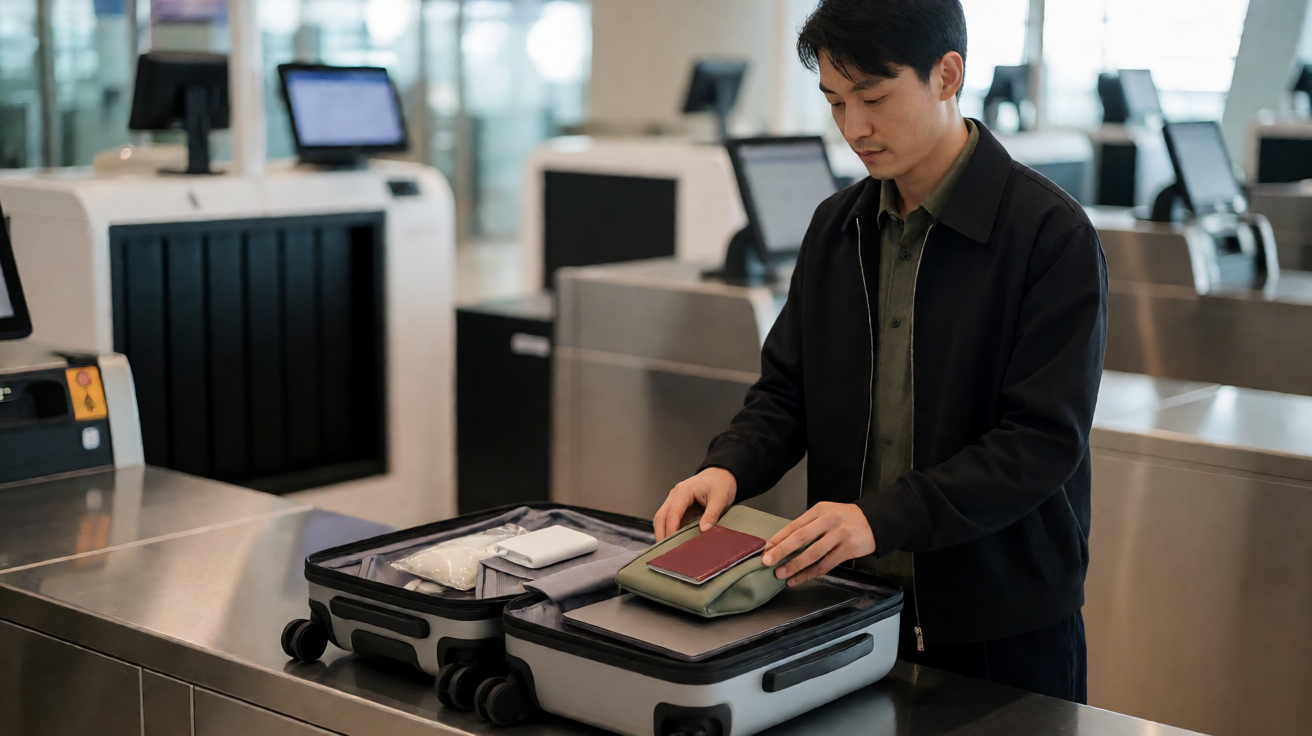
Airport security rules can differ between international and domestic segments, and airlines can add their own baggage conditions. For a smooth domestic flight in China, pack conservatively, keep documents and electronics accessible, and check the operating airline’s current page shortly before leaving for the airport.
Carry-on liquids: domestic rules are stricter than many travelers expect
For domestic flights in China, the published rule is not simply the familiar international “100 ml bag” rule. Air China’s English notice says liquids are generally prohibited in carry-on baggage on domestic flights, with a limited exception for a small amount of personal cosmetics: one item of each type in a container no larger than 100 ml, in a separate bag and subject to inspection. Read Air China’s official notice.
Plan to put ordinary liquids into checked baggage when possible. For an international arrival connecting to a domestic flight, duty-free liquids may be allowed only when they remain in an intact, sealed transparent bag and you can show proof of purchase. Medicines, infant needs and special medical items can have separate requirements, so contact the airline in advance and carry relevant documentation.
Power banks and spare batteries: keep them with you
China’s Civil Aviation Administration has tightened domestic-flight control of power banks. Its 2025 notice says that, from June 28, 2025, passengers may not carry power banks without CCC markings, with unclear CCC markings, or from recalled models or batches on domestic flights. Read the CAAC notice.
The CAAC travel guide also says power banks belong in carry-on baggage or on your person, not in checked baggage. It states that a power bank at or below 100 Wh does not need airline approval; over 100 Wh and up to 160 Wh needs airline approval and is limited to two; above 160 Wh is prohibited. See the CAAC travel guide.
Practical checklist:
- Check that the power bank has a clear CCC marking and readable capacity label.
- Keep it in your cabin bag, not the checked suitcase.
- Protect spare batteries from short circuits; separate them from loose metal objects.
- Do not bring a recalled or damaged power bank.
- Check your operating airline’s latest policy before travel.
Carry-on size and checked baggage are different questions
Security acceptance is not the same as your fare’s baggage allowance. Your airline decides what your ticket includes; a low-cost fare may have a smaller or no free checked-bag allowance.
The CAAC guide lists a common domestic carry-on reference of up to 5 kg and 20 × 40 × 55 cm per piece, while warning that airlines can have special limits. CAAC carry-on guidance. Use the allowance shown in your booking as the final rule, especially if you have a basic fare, a code-share or multiple airlines on one itinerary.
Keep valuables, passports, medications, cameras, laptops, cash and essential documents in your carry-on. Do not put spare lithium batteries in checked baggage. If you are transporting sports gear, a musical instrument, a pet or an oversized item, arrange it with the airline before travel.
Items that can cause a last-minute problem
Do not assume an item is permitted simply because it fits in a suitcase. Air China’s prohibited-items page lists gases, flammable substances and lithium-powered personal transport devices such as hoverboards, scooters and bicycles among items not accepted as ordinary checked or carry-on baggage. Read the airline’s restricted-items guidance.
Knives, tools, aerosols, alcohol, lighters, batteries and electronic devices can all involve special conditions. When an item is expensive or important, use the airline’s official dangerous-goods and baggage pages before you pack rather than relying on a third-party packing list.
A fast pre-airport routine
The night before, put passport, booking reference, phone, power bank, charger, medicines and valuables in one cabin bag. Move non-essential liquids and borderline items to checked baggage only where airline rules allow. Recheck your terminal, baggage allowance and the official power-bank rule. Arrive early enough to repack or ask staff if security has a question.
This small routine is far cheaper than losing an item at security or missing boarding while trying to rearrange luggage.
Research questions before you pack
Reader perspective
- Which items must stay in my carry-on because they are valuable, essential or battery-powered?
- Does my power bank have a clear CCC mark and readable Wh or capacity label?
- Which liquids can I leave in checked baggage rather than take to domestic security?
- What checked-bag and cabin-bag allowance does my exact fare include?
SEO / People Also Ask perspective
- Can I take a power bank on a domestic flight in China?
- Are liquids allowed in carry-on baggage on China domestic flights?
- What is the carry-on baggage size limit for domestic flights in China?
- Can I pack lithium batteries in checked luggage in China?
Competitor-gap perspective
- Does my power bank meet the current CCC-marking requirement as well as capacity rules?
- Am I connecting from an international flight, where duty-free liquid handling may differ?
- Which rules come from airport security and which come from my specific airline fare?
Bottom line
For a domestic China flight, pack batteries and valuables in your carry-on, treat liquids cautiously, verify your power bank’s marking and capacity, and read your airline’s current allowance. The exact ticket and route always beat a generic packing rule.