China Visa Guide 2026: Everything First-Time Visitors Need to Know#
In 2025, roughly 41 million foreign tourists visited mainland China — a 26.4% jump from the year before, according to the National Immigration Administration. The single biggest reason? China made it dramatically easier to get in.
Here’s the thing, though: most of what you’ve read online about China’s visa process is outdated. Blog posts still tell you to book flights before applying, bring hotel confirmations, and schedule an embassy appointment. For US-based applicants, none of that has been true since January 2024.
This guide gives you the exact, current requirements for 2026 — backed by official embassy sources, verified fee schedules, and the latest policy changes (including visa-free entry for UK and Canadian citizens). Whether you’re planning a two-week vacation or considering a 10-year multiple-entry visa, here’s what you actually need to know.
Key Takeaways
- 50+ countries (including the UK, Canada, and Australia) now enjoy 30-day visa-free entry to China through at least December 31, 2026. (NIA, 2026)
- US citizens pay a flat $140 for a tourist visa — including the 10-year multiple-entry option — with no flight or hotel bookings required. (Chinese Embassy in the US, 2025)
- The 240-hour (10-day) visa-free transit policy covers 55 countries and 65 ports, and allows cross-province travel across 24 regions. (NIA Transit Policy, 2026)
- Regular processing takes 4 business days; express service adds just $25 (US).
For more on planning your trip, check our complete China travel planning guide for payment setup, SIM cards, and getting around.
Wait — Do You Even Need a Visa? China’s Visa-Free Options in 2026#
If you hold a passport from the UK, Canada, Australia, or dozens of other countries, you might not need a visa at all. China’s unilateral visa-free policy now covers 50 nations, granting 30-day stays for tourism, business, or family visits through December 31, 2026 (NIA, 2026). The numbers confirm it’s working: 30.08 million of China’s 2025 foreign arrivals — 73.1% of all foreign visitors — entered through visa-free channels (NIA Annual Report, 2025).

Who qualifies for 30-day visa-free entry?#
Europe (34 countries): Austria, Belgium, Bulgaria, Croatia, Cyprus, Denmark, Estonia, Finland, France, Germany, Greece, Hungary, Iceland, Ireland, Italy, Latvia, Liechtenstein, Luxembourg, Malta, Monaco, Montenegro, Netherlands, North Macedonia, Norway, Poland, Portugal, Romania, Slovakia, Slovenia, Spain, Sweden, Switzerland, and the United Kingdom.
Americas (5 countries): Argentina, Brazil, Canada, Chile, Peru, and Uruguay.
Asia-Pacific (5 countries): Australia, Brunei, Japan, New Zealand, and South Korea.
Middle East (4 countries): Bahrain, Kuwait, Oman, and Saudi Arabia.
Russia operates under a separate arrangement — 30-day visa-free stays through September 14, 2027.
What about mutual visa exemption agreements?#
An additional 29 countries have mutual agreements with China, offering 30-to-90-day visa-free stays. Popular ones include Singapore (30 days), Thailand (30 days), Malaysia (30 days), the United Arab Emirates (30 days), Kazakhstan (30 days), and Armenia (90 days).
Important caveats#
Visa-free entry is not the same as visa-on-arrival. You just show up with your passport. But here’s the catch: you cannot extend a visa-free stay from inside China. If there’s any chance you’ll want more than 30 days, apply for an L visa instead.
Also — you still need to register your accommodation within 24 hours of arrival. Hotels handle this automatically. If you’re staying with friends or in a private rental, you’ll need to visit the local police station yourself. Miss this step and you could face fines when you try to leave.
Citation capsule: China’s unilateral visa-free policy covers 50 countries for 30-day stays through December 31, 2026. In 2025, 30.08 million foreign arrivals — 73.1% of all foreign visitors — used visa-free channels, a 49.5% year-on-year increase. (National Immigration Administration, 2025)
See the full list of China visa-free countries with stay durations for complete eligibility details.
What Is the 240-Hour Visa-Free Transit? (And Why It’s Underused)#
Not eligible for visa-free entry? There’s still a good chance you can visit China without a visa. The 240-hour (10-day) transit exemption applies to citizens of 55 countries — including the United States — arriving through 65 designated ports across 24 provinces (NIA Transit Policy Update, 2026). It replaced the old 72-hour and 144-hour policies in December 2024.

How does it work?#
The rules are straightforward:
- You must be transiting through China to a third country (your departure and destination must be different)
- Hong Kong, Macau, and Taiwan count as third regions for routing purposes
- You need a confirmed onward ticket with a date and seat number departing within 240 hours
- Your passport must have at least 3 months of remaining validity
- You can travel across all 24 eligible provinces — no more being locked to one city
Time is calculated from 00:00 on the day after you enter. So if you arrive at 3 PM on Monday, your 240 hours start at midnight Tuesday morning.
“The Hong Kong Backdoor”#
Here’s a strategy most guides won’t tell you about. Fly from the US (or Europe) to Hong Kong. Take the high-speed rail from West Kowloon station straight into mainland China — it’s one of the 65 eligible ports. Travel for up to 10 days across 24 provinces. Then fly out to a third country or region (Japan, Thailand, the Philippines — anywhere that isn’t your original departure point).
That’s a full China trip without filling out a single visa form.
What’s off-limits?#
You need a clean record — no Chinese visa refusal stamps, illegal entry, or employment violations in the past five years. International crew members and their families aren’t eligible. And don’t overstay the 240 hours; penalties include fines and potential deportation.
First-hand tip: The cross-province freedom is the real upgrade here. Under the old 144-hour policy, you were often stuck in the province where you arrived. Now you can land in Guangzhou, take the bullet train to Shanghai, and fly out of Beijing — all on the same transit exemption.
For port-by-port details and sample itineraries, see our 240-hour visa-free transit walkthrough.
What Type of China Visa Do I Need? A Quick-Reference Guide#
For tourism, you need an L visa — full stop. But China has 16 visa categories, and picking the wrong one is a common rookie mistake. Here’s a quick breakdown of the ones most relevant to first-time visitors (Chinese Embassy, 2025):

| Visa Type | Purpose | Duration |
|---|---|---|
| L | Tourism (sightseeing, leisure) | Up to 60 days per entry (10-year available for some nationalities) |
| M | Business & trade activities | Varies |
| F | Exchanges, study tours, cultural visits | Up to 90 days |
| Q1/Q2 | Family reunion / visiting relatives | Q1: 180+ days; Q2: up to 180 days |
| X1/X2 | Study | X1: 180+ days; X2: up to 180 days |
| Z | Employment | Varies (requires work permit) |
| G | Transit | Short-term |
| S1/S2 | Visiting family of foreign residents in China | S1: 180+ days; S2: up to 180 days |
The L Visa — your tourist ticket#
The L visa is strictly for tourism. Working, freelancing, or doing any income-earning activity on an L visa is illegal and can result in fines, detention, or deportation. Don’t risk it.
Here’s the good news for certain nationalities: citizens of the US, UK, Canada, Argentina, and Israel can receive a 10-year multiple-entry L visa. Each stay is limited to 60 days, but you can come and go as many times as you want over a decade.
Overstaying your permitted duration? That’ll cost you CNY 500 per day, plus potential detention and a re-entry ban. Always check your visa’s “duration of each stay” field before you travel.
Need help choosing? Our China visa types comparison guide breaks down every category with examples.
How to Apply for a China Tourist Visa — Step by Step#
The L visa application process is now simpler than most people expect — especially if you’re applying in the United States, where the appointment requirement has been eliminated and several document requirements were dropped in January 2024 (Chinese Embassy in the US, 2024). The entire process typically takes about 10 days from start to finish.

Step 1: Complete the COVA Online Application#
Go to the China Online Visa Application (COVA) system and fill out the form. You’ll need personal details, family info, work and education history, and travel information.
Photo requirements are strict: 33mm × 48mm, color photo, pure white background, no glasses, no jewelry, no patterned clothing, no smiling. Don’t use a selfie or a photo booth — go to a professional studio and tell them it’s for a Chinese visa.
Timing tip: The system only accepts entry dates within 90 days of your application. Don’t fill it out six months early; it won’t let you proceed.
First-hand tip: The COVA form is detailed but not difficult. The most frustrating part? The photo upload. The system is picky about file size, dimensions, and background purity. If your photo gets rejected three times, take a breath and go to a professional studio — it saves hours of frustration.
Step 2: Prepare Your Documents#
Once you’ve completed the COVA form and uploaded your documents, you’ll enter the review queue. When your status changes to “Passport to be submitted”, it’s time to gather your physical documents. (We’ll cover the exact checklist in the next section.)
Step 3: Submit In Person — No Appointment Needed#
In the US, Chinese embassies and consulates operate on a walk-in basis — no appointment necessary. You can submit your passport and documents yourself, or send a friend, family member, or visa agent on your behalf. No power of attorney is required.
But don’t just show up. Wait until your online application status shows “Passport to be submitted” first.
Step 4: Biometrics and Interview#
Here’s some welcome news: fingerprint collection is exempted for all short-term visa applicants (stays of 180 days or less) through December 31, 2026. That includes the tourist L visa (Chinese Embassy, 2025).
In-person interviews are generally not required, though consular officers reserve the right to request one if they see something in your application that needs clarification.
For UK applicants: The rules differ. The CVASC in London requires all applicants aged 14-70 to appear in person, and fingerprint collection has not been exempted in the UK. Plan accordingly.
Step 5: Pick Up Your Visa#
Track your application status online. When it shows “Passport to be collected,” bring your pick-up slip to the visa office. You’ll pay the fee at pickup — not at application (NY Consulate General, 2025).
Accepted payment at US embassies: Visa, Mastercard, or UnionPay credit cards; money orders; cashier’s checks; WeChat Pay; and Alipay. They do not accept cash, personal checks, or online payments.
Citation capsule: Since January 2024, Chinese embassies and consulates in the United States no longer require tourist visa applicants to submit round-trip flight bookings, hotel reservations, travel itineraries, or invitation letters. The appointment system has also been eliminated. (Chinese Embassy in the US, 2024)
Prefer a visual walkthrough? Our China visa application video tutorial covers every screen of the COVA system.
What Documents Do You Actually Need? (The Honest Checklist)#
For US-based applicants, the document list is surprisingly short since the January 2024 simplification. Here’s exactly what you need — and what you don’t (Chinese Embassy, 2025):

Documents to upload online:#
- ✅ Passport bio-page (must have 6+ months validity and at least 2 blank visa pages)
- ✅ Visa Application Statement (download from embassy site, requires handwritten signature)
- ✅ Latest Chinese visa or residence permit (if you’ve had one before)
- ✅ Proof of residence in the consular jurisdiction (driver’s license, utility bill, or bank statement)
- ✅ Green card, visa, I-20, or I-94 (if you’re a foreigner living in the US)
- ✅ Naturalization certificate + last Chinese passport bio-page (if you’re a former Chinese citizen applying for the first time after naturalization)
Documents to bring in person:#
- ✅ Original passport
- ✅ Printed application info-page showing “Passport to be submitted” status and barcode
- ✅ Old passport (if it contains a previous valid Chinese visa)
What you do NOT need (US applicants):#
- ❌ Round-trip flight booking — not required since January 2024
- ❌ Hotel reservation — not required since January 2024
- ❌ Travel itinerary — not required since January 2024
- ❌ Invitation letter — not required since January 2024
If you’re applying outside the US#
Requirements vary significantly by country. In most non-US locations, you may still need to provide flight bookings, hotel reservations, a detailed travel itinerary, and proof of sufficient funds. Always check your local Chinese embassy or consulate’s website — don’t assume the US simplification applies everywhere.
What most guides won’t tell you: The US-specific simplification is unusual. China hasn’t extended the same document reduction to other countries on the same scale. If you’re applying from the UK, Australia, or elsewhere, prepare the full document package (flights, hotels, itinerary) just in case.
For country-specific requirements, see our China visa document checklist by country.
How Much Does a China Visa Cost? (Exact Fees by Nationality)#
For US citizens, the China tourist visa costs a flat $140 regardless of whether you choose single-entry, double-entry, or the 10-year multiple-entry option (NY Consulate General, 2025). At $14 per year over a decade of unlimited entries (60 days each), that’s one of the best values in international travel visas.
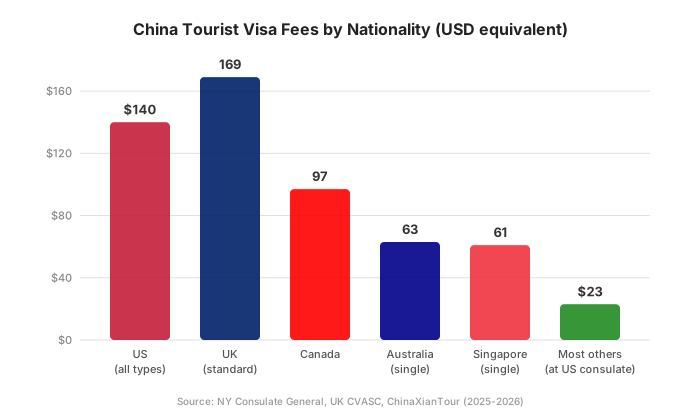
Fee breakdown by nationality#
| Nationality | Regular Fee | Express (+) | Urgent/Rush (+) |
|---|---|---|---|
| United States | $140 (all entry types) | $165 (+$25) | $177 (+$37) |
| United Kingdom | £130 (standard) | £161 (+£31) | £182 (+£52) |
| UK 10-year | £257 | £288 (+£31) | £309 (+£52) |
| Canada | CAD 132.75 | CAD 197.15 (+$64.40) | CAD 240.50 (+$107.75) |
| Australia (single) | AUD 94.50 | AUD 152 (+$57.50) | AUD 194 (+$99.50) |
| Australia (multiple 1yr+) | AUD 184.50 | AUD 242 (+$57.50) | AUD 284 (+$99.50) |
| Singapore (single) | S$80 | S$146 (+$66) | S$191 (+$111) |
| France | ~€111 | Varies | Varies |
| Germany | ~€110 | Varies | Varies |
Sources: NY Consulate General, UK CVASC via TravelChinaGuide, ChinaXianTour Fee Guide. Fees include CVASC service charges where applicable.
Why the huge fee difference?#
It comes down to reciprocity. China charges US citizens $140 because the US charges Chinese citizens a similar amount for a US visa. Most other nationalities pay significantly less at Chinese consulates in the US — often just $23 for a single-entry visa — because their countries charge Chinese citizens less in return.
When and how to pay#
You pay at pickup, not at application. Accepted payment methods at US embassies and consulates include credit cards (Visa, Mastercard, UnionPay only), money orders, cashier’s checks, WeChat Pay, and Alipay. No cash, no personal checks, no online payments.
Citation capsule: US citizens pay a flat $140 for a China tourist visa covering all entry types, including the 10-year multiple-entry option. Express service adds $25 (2-3 business days); rush service adds $37 (1 business day). (NY Consulate General, 2025)
Wondering about the full trip budget? Our China trip cost breakdown covers everything from flights to street food.
How Long Does Processing Take? (And When Should You Apply?)#
Regular processing takes 4 business days from the date you physically hand over your passport at the embassy or consulate — not from when you submit the COVA form online (Chinese Embassy in the US, 2025).
| Service | Time | Extra Cost (US) |
|---|---|---|
| Regular | 4 business days | — |
| Express | 2-3 business days | +$25 |
| Rush | 1 business day | +$37 (emergency only, requires consular approval) |
The #1 timing mistake#
Many applicants assume the clock starts when they click “submit” on the COVA website. It doesn’t. Processing begins only after you’ve physically dropped off your passport. Factor in 2-5 days for the online review before you even reach that point.
Recommendation: Start the COVA application about 1 month before your planned travel date. That gives you enough buffer for online review, passport submission, and any unexpected delays.
Citation capsule: China visa processing times start from the date of physical passport submission, not the online COVA submission. Regular service takes 4 business days; express service is 2-3 days for an additional $25 (US). (Chinese Embassy in the US, 2025)
Is There a China E-Visa or Fully Online Application?#
No. China does not offer a fully electronic visa. What it has is the COVA system — a hybrid that handles most of the paperwork online but still requires at least one in-person visit.
Here’s the flow: fill out the form and upload documents on the COVA website → wait for online review → when status shows “Passport to be submitted,” bring your physical passport and printed documents to the embassy or visa center → pick up your visa in person when it’s ready.
There’s no mail-in option. No fully remote process. Online review approval doesn’t guarantee visa issuance — consular officers can still request an interview or additional documents.
Our COVA system visual walkthrough shows you every screen and field with screenshots.
Why Do China Visa Applications Get Rejected? (10 Mistakes to Avoid)#
The most common reason for rejection? Simple errors on the application form — misspelled names, missing fields, or information that doesn’t match the passport (Visa Application Guides, 2026). Most rejections are entirely preventable.

The 10 most common mistakes:#
1. Inaccurate or incomplete forms. A single misspelled name or wrong date can get your application returned. Double-check every field against your passport — character by character.
2. Missing documents. Use the checklist in the previous section. Missing even one required item delays your application.
3. Passport doesn’t meet requirements. Less than 6 months of validity remaining? Fewer than 2 blank pages? Visible damage? Any of these will get you turned away at the counter.
4. Non-compliant photos. China’s photo rules are stricter than most countries: 33mm × 48mm, pure white background, no glasses, no jewelry, no patterned clothing, no smiling, ears must be visible.
First-hand tip: The photo requirement catches more people than anything else. I’ve seen applications returned for photos where the background had a slight blue tint, where the applicant was wearing a striped shirt, and where they were caught mid-smile. Go to a professional photo studio and specifically tell them it’s for a Chinese visa — they’ll know the specs.
5. Insufficient financial proof. Bank statements showing a low balance or sudden large deposits right before applying can raise red flags. Officers want to see stable, sufficient funds — not a friend transferring you $10,000 the week before.
6. Vague travel plans. Even though US applicants no longer need to submit an itinerary, if you’re applying elsewhere, a vague or generic cover letter weakens your case. Write something specific and personal.
7. Weak ties to your home country. Can’t show employment, property ownership, or other commitments that demonstrate you’ll return home? This makes officers nervous. Bring an employment letter or proof of enrollment in school.
8. Previous visa or legal issues. Past overstays, visa refusals, or criminal records don’t automatically disqualify you, but they invite extra scrutiny. Be upfront — dishonesty is worse than the issue itself.
9. Fake or forged documents. This is the fastest way to get a permanent ban. Forged bank statements, fake invitation letters, or altered passports will get you rejected and potentially barred from future applications.
10. Sensitive occupation. If you work in media, journalism, defense, or national security-related fields, expect additional review time. Apply early and be prepared for follow-up questions.
Citation capsule: The most common reason for China visa rejection is inaccurate or incomplete application forms, followed by passport validity issues and non-compliant photos. Submitting forged documents can result in a permanent application ban. (Chinese Visa Application Guides, 2025)
Already got rejected? Our China visa rejection troubleshooting guide walks you through next steps.
What If You Need More Time? Extending Your Visa Inside China#
Already in China and want to stay longer? You can extend your visa at the local Public Security Bureau (PSB) Exit and Entry Administration — but only if you entered with a visa. Visa-free entrants cannot extend their stay from inside China (TravelChinaGuide, 2025).
Where and when to apply#
Go to the PSB Exit and Entry Administration office at the county level or above. Major cities have dedicated centers with better English-language service. Smaller offices may not have English speakers, so bring a Chinese-speaking friend if you can.
Apply at least 7 days before your current visa expires. The PSB has up to 7 days to make a decision. For long-term visas (Z work visa or X student visa), submit your extension request 15-30 working days before expiry.
What you’ll need#
- Original passport
- Recent passport photo
- Temporary accommodation registration form (hotels provide this; private stays require a police station visit)
- Reason for extension (for tourist visas: a written travel plan or itinerary)
- Completed application form (filled out on-site)
Cost and duration#
| Nationality | Extension Fee |
|---|---|
| Most countries | CNY 160 |
| United States | CNY 760 |
| United Kingdom | CNY 469 |
Standard extensions are for 1 month. The total extended stay cannot exceed your original visa’s permitted duration. The new visa takes effect from its issue date (not your original entry date), and your old visa is cancelled simultaneously.
Can someone else apply for you? Yes — if you’re under 16, over 60, have mobility difficulties, have a good prior travel record in China, or have an inviting entity sponsoring your visit.
For detailed extension instructions by city, see our China visa extension inside-country guide.
Traveling with Kids? Special Visa Rules for Families#
Every minor, regardless of age, needs their own China visa — children cannot be included on a parent’s visa (VisaTitans, 2025). The application process mirrors adults’, with additional documentation requirements that depend on who’s traveling with the child.
| Scenario | Extra Documents Required |
|---|---|
| Both parents traveling | Child’s birth certificate + copies of both parents’ passports |
| One parent traveling | Birth certificate + notarized consent letter from the absent parent + absent parent’s passport copy |
| Child traveling alone or with a guardian | Notarized consent from both parents + both parents’ passport copies + invitation letter from guardian in China + guardian’s ID or residence permit |
| Adopted child | Adoption decree + legal guardianship documents |
| Divorced parents | Court custody order + notarized consent from the custodial parent |
The consent letter should include the child’s travel dates, details of their stay in China, and the designated guardian’s information. It may need to be translated into Chinese and authenticated by the relevant authorities, depending on your country.
For first-time applicants who are minors of Chinese origin born in the US, follow the specific guidance on the Chinese Embassy’s website.
Planning a family trip? Our China family travel guide covers kid-friendly itineraries, stroller accessibility, and more.
Quick-Reference: Embassies, Visa Centers & Office Hours#
US — Embassy of the PRC in Washington, D.C.#
| Detail | Info |
|---|---|
| Address | 2201 Wisconsin Avenue NW, Suite 110, Washington, D.C. 20007 |
| Office hours | Monday–Friday, 9:30 AM – 2:30 PM (closed on holidays) |
| Phone | +1-202-495-2071 (12:30–4:30 PM weekdays) |
| [email protected] | |
| Appointment | Not required — walk-in service |
| Jurisdiction | D.C., Maryland, Virginia, West Virginia, North Carolina, South Carolina, Kentucky, Tennessee, Delaware, Alabama, Arkansas, Florida, Georgia, Louisiana, Mississippi, Oklahoma, Texas, Puerto Rico |
Other US consulates#
China has consulates general in New York, Chicago, San Francisco, and Los Angeles, each serving specific states. Check consular jurisdiction before you go — submitting to the wrong office will get your application returned.
UK — CVASC London#
Applicants aged 14-70 must appear in person. Express service applications must be submitted before 11:00 AM. Mail-back service is available for an additional fee.
Find your local center#
- CVASC global directory: visaforchina.org
- China Ministry of Foreign Affairs: cs.mfa.gov.cn
- Chinese Embassy in the US: us.china-embassy.gov.cn
- Chinese Embassy in the UK: gb.china-embassy.gov.cn
See our complete directory of Chinese embassies and consulates worldwide for addresses, hours, and contact info.
Frequently Asked Questions#
Do US citizens need a visa for China?#
Yes. US citizens are not on China’s visa-free list (as of 2026). You need an L visa for tourism, which costs $140 and covers all entry types including the 10-year multiple-entry option. However, US citizens are eligible for the 240-hour visa-free transit exemption if you’re flying onward to a third country. (Chinese Embassy in the US, 2025)
See our US citizen China visa guide for nationality-specific details.
Do UK citizens need a visa for China?#
Not for stays up to 30 days. Since February 17, 2026, UK citizens enjoy visa-free entry for tourism, business, or family visits. For longer stays or multiple entries, apply for an L visa through the CVASC London center (£130 standard, £161 express). (NIA, 2026)
Can I get a China visa online?#
No fully electronic visa exists. The COVA system handles the online portion of the application, but you must submit your physical passport in person at an embassy, consulate, or CVASC center. There is no mail-in option.
How long is a China tourist visa valid?#
For US, UK, Canadian, Argentine, and Israeli citizens: up to 10 years (multiple entry, 60 days per stay). For most other nationalities, a single-entry visa is typically valid for 3 months with stays of 30-60 days. (Chinese Embassy, 2025)
Can I work on a China tourist visa?#
Absolutely not. The L visa is strictly for tourism. Any employment — including remote freelancing, consulting, or “gig work” — requires a Z (work) visa. Violating this can result in fines, detention, and deportation.
What happens if I overstay my China visa?#
You’ll face a fine of CNY 500 per day of overstay. Serious overstays can lead to detention, deportation, and a ban on re-entering China. If you realize you’re running out of time, apply for an extension at the PSB Exit & Entry Administration at least 7 days before your visa expires. (TravelChinaGuide, 2025)
Can I extend my China visa from inside China?#
Yes — at the local PSB Exit & Entry Administration (county level or above), at least 7 days before your visa expires. The extension costs CNY 160 for most nationalities, CNY 760 for US citizens. Visa-free entrants cannot extend. (TravelChinaGuide, 2025)
Do children need a separate China visa?#
Yes. Every person, regardless of age, needs their own visa. If a child is traveling with only one parent, the absent parent must provide a notarized consent letter. Solo minors need consent from both parents plus a designated guardian in China. (VisaTitans, 2025)
What’s the cheapest way to visit China without a visa?#
Check visa-free eligibility first — 50+ countries qualify for 30-day stays. If your country isn’t on that list, the 240-hour transit exemption is free — you just need a confirmed onward ticket to a third country. No forms, no fees. (NIA, 2026)
Can I use the transit exemption through Hong Kong?#
Yes. Hong Kong West Kowloon high-speed rail station is one of the 65 eligible ports. Since Hong Kong counts as a “third region,” you can fly from your home country to Hong Kong, take the train into mainland China, travel for up to 10 days, and fly out to a different destination. (NIA Transit Policy, 2026)
For more answers, browse our complete China visa FAQ with 50+ questions.
Wrapping Up: Your China Visa Checklist#
Let’s boil this down to what matters:
- Check visa-free eligibility first. 50+ countries (including the UK, Canada, and Australia since early 2026) get 30 days with no paperwork.
- US citizens: that $140 visa covers 10 years. Don’t settle for a single-entry when the 10-year multiple-entry costs the same.
- The process is simpler than you think. No appointments, no flight bookings, no hotel reservations (for US applicants). Fill out the COVA form, wait for approval, drop off your passport, pick it up 4 days later.
- Don’t underestimate the photo requirements. They’re strict. Go to a professional.
- The 240-hour transit exemption is underused. If you can route through China to a third country, you get 10 days visa-free — no forms, no fees.
- Apply about a month before travel. Processing is fast (4 days), but the online review adds time, and unexpected delays happen.
China welcomed 41 million foreign visitors in 2025. The visa process isn’t the obstacle it used to be. Get your paperwork in order, follow the steps above, and you’ll be exploring Beijing or wandering Shanghai’s Bund before you know it.
Questions about your specific situation? Drop them in the comments — I respond to every one.
Ready to start planning? Check out our guides on how to plan your first trip to China, payment methods for foreigners in China, and our most popular China itineraries for inspiration.